As executive director of the Texas Medical Center (TMC) Library in Houston, Katie Prentice MSIS ‘04 oversees a $9 million budget, a staff of 34 and information services for two major medical schools. Her path to this position, so crucial in supporting world-class medical training and life-saving research, was not determined by a lifelong ambition to lead a large organization. In fact, as an iSchool student, when a professor asked her class to raise hands if they aspired to a high-level management position, Prentice kept her hand down.
Instead, she has been guided in her professional trajectory by curiosity, openness to change and a lifelong attraction to being around learners. Those values have made Prentice a perfect fit for academic libraries where, despite many shifts in technology, the shared purpose remains the same. “Everybody is learning something,” she says. “They're doing research. They're growing.”
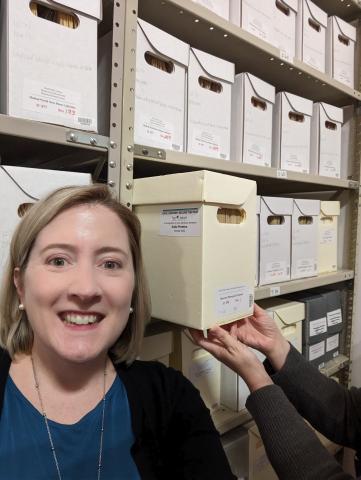
Growing Up in the Stacks
As a kid in Austin, Prentice had a family ritual: her mother would take her and her sister to the library, hand them each a paper bag and let them fill it with as many books as they could carry. She remembers stacking hers to the top then going home and diligently reading through the haul. "Reading was a big deal to my family," she says.
Still, Prentice never considered a career as a librarian – not even when she served as student librarian for the Austin High School marching band, tracking compliance with sheet music licenses, a role she describes jokingly as “the beginning of my life in the copyright police.”
As an undergraduate at UT, her learning was voracious but not career focused. She began in natural sciences, switched to a government major, and taught herself to code in her dorm room. After graduation, she followed her curiosity even further afield, pressing pause on career questions for a two-year stint in the Peace Corps.
A Peace Corps Epiphany
Assigned to Latvia, Prentice taught English to high schoolers and joined a community choir that won a spot in the National Song and Dance Festival. As her Peace Corps group, the last scheduled to serve in Latvia before the country joined the EU, prepared to close its office, Prentice and fellow volunteers realized that a filing cabinet full of a decade's worth of lesson plans and teaching materials would be lost. They secured a small grant to digitize and distribute those materials for use by Latvian schools.
It was another brush with library work – this time with digital technology in the mix. "Later, in graduate school, I learned that was organizing and providing access to information," Prentice says. "For me, it was an epiphany how much I enjoyed that project." That insight dovetailed with medical crisis, as Prentice was evacuated from Latvia for heart surgery to address a congenital defect. She applied to the iSchool and took the GRE between two procedures.
Finding Direction at the iSchool
Back on the Forty Acres, Prentice found herself preparing for an information sciences career that would look quite different from her childhood library memories. In fact, it was a digital media class at the iSchool that gave her a portfolio of hands-on, project-based experience that, combined with HTML skills she'd taught herself in college, helped her land her first academic library job.
Prentice credits her iSchool advisor, Loriene Roy, with pushing her to consider both global perspective and local community responsibility in her work. "I take that with me every day,” she says. A marketing class taught by Glynn Harmon also left a lasting mark. At libraries, she says, “Everything we do is marketing. Everything is outreach.”
A Career in Health Sciences Libraries
That first academic library job was web services librarian at the Briscoe Library for UT Health San Antonio. She later moved into reference and instruction, eventually leading that team. Next, she took a role with the University of Oklahoma-Tulsa's Schusterman Library, where she gained important leadership and budget experience while trying her best to lay low as a die-hard Longhorn.
In late 2020, mid-pandemic, Prentice moved to Houston to take the reins of the TMC Library, an independent nonprofit that provides contract library services to several member institutions, including Baylor College of Medicine, UTHealth Houston and MD Anderson. In short, she oversees the information support institution for one of the world’s leading medical hubs. “It's a wild and dynamic place where there's always something going on,” she says.
Preserving History, Facing the Future
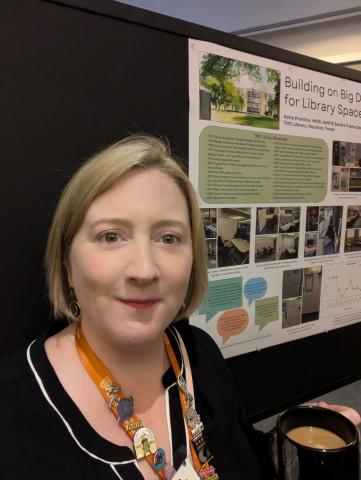
At TMC Library, Prentice oversees everything from connecting a surgery resident with a specialized text on a novel procedure to safeguarding the records of the Atomic Bomb Casualty Commission for future generations. In the collections, she has been excited to pivot to unlimited-use e-books, and in the physical space she’s proud of her forward-looking introduction of monitor docking stations to replace outdated shared-desktop clusters. Today, she sometimes sees researchers at work in her library on as many as five screens.
Prentice pushes back on the notion that new technology threatens librarians' relevance. “The job titles will change, maybe even the word ‘library’ will change, but the work we do in universities and the health sciences is not going to stop,” she says. “It's just getting busier and more complicated, which is exciting.”
She sees librarians increasingly guiding students and researchers through generative AI tools and the growing volume of scholarly information, helping them evaluate what's trustworthy. "Finding the good stuff and sorting it from the lower-quality stuff is more important than ever," she says.
Advice for iSchool Students
Asked what she'd tell current and prospective students, Prentice highlights a few key themes:
- Stay intellectually curious. Look at new tools and technologies as an ongoing opportunity to add value. "Change is normal," she says. "Embrace it."
- Think both big and small. Long-term vision matters, but so does solving the specific problems in front of you.
- Put people first. Communication skills are as essential as any technical training. "We're not just sitting back here with a stack of books," she says. "We’re thinking about our community, their needs and what we can do together to change the world."
Learn more about iSchool alumni who are changing the world at https://ischool.utexas.edu/news.