
Near the end of each semester, the iSchool holds a capstone poster session, where graduating students present on a research project that has played a culminating role in their degree journey. This spring’s event, held on Friday, April 24th, 2026 at the Etter-Harbin Alumni Center, was among the most memorable in iSchool history. 174 students presented work — 103 MSIS projects and 71 undergraduate informatics projects spanning areas such as accessibility, AI/ML, archives, data science, libraries, product management, UX design and UX research.
"The showcase was buzzing with energy and was a great opportunity to celebrate the excellent work of our students,” says Interim Dean Ken Fleischmann. “The student work presented at the capstone showcase was a tribute to the interdisciplinarity and excellence of our Informatics and MSIS programs."
Four students – two graduate students and two undergraduates – received special recognition in research excellence by the dean, with the assistance of a team of iSchool professors, including Interim Associate Dean for Academic Affairs James Howison, Capstone Director John Neumann, and capstone instructors Andrea Baer and Dave Yeats. The winning students are Aleena Jacks, Kyle Castillo, Lucas McGill and Marsh Vo.
"The awardees all did high-quality work that has the potential to positively impact the lives of Texans," Fleischmann says. "Many thanks to Capstone Director Neumann and capstone instructors Baer and Yeats for all of their great work this semester on behalf of the iSchool!"
Read on below to learn more about the 2026 Dean’s Excellence awards winners and honorable mentions. Congratulations to these four graduating students, and to all who shared their original, thought-provoking, and career-building work!
Aleena Jacks, Graduate Dean's Choice Award Winner
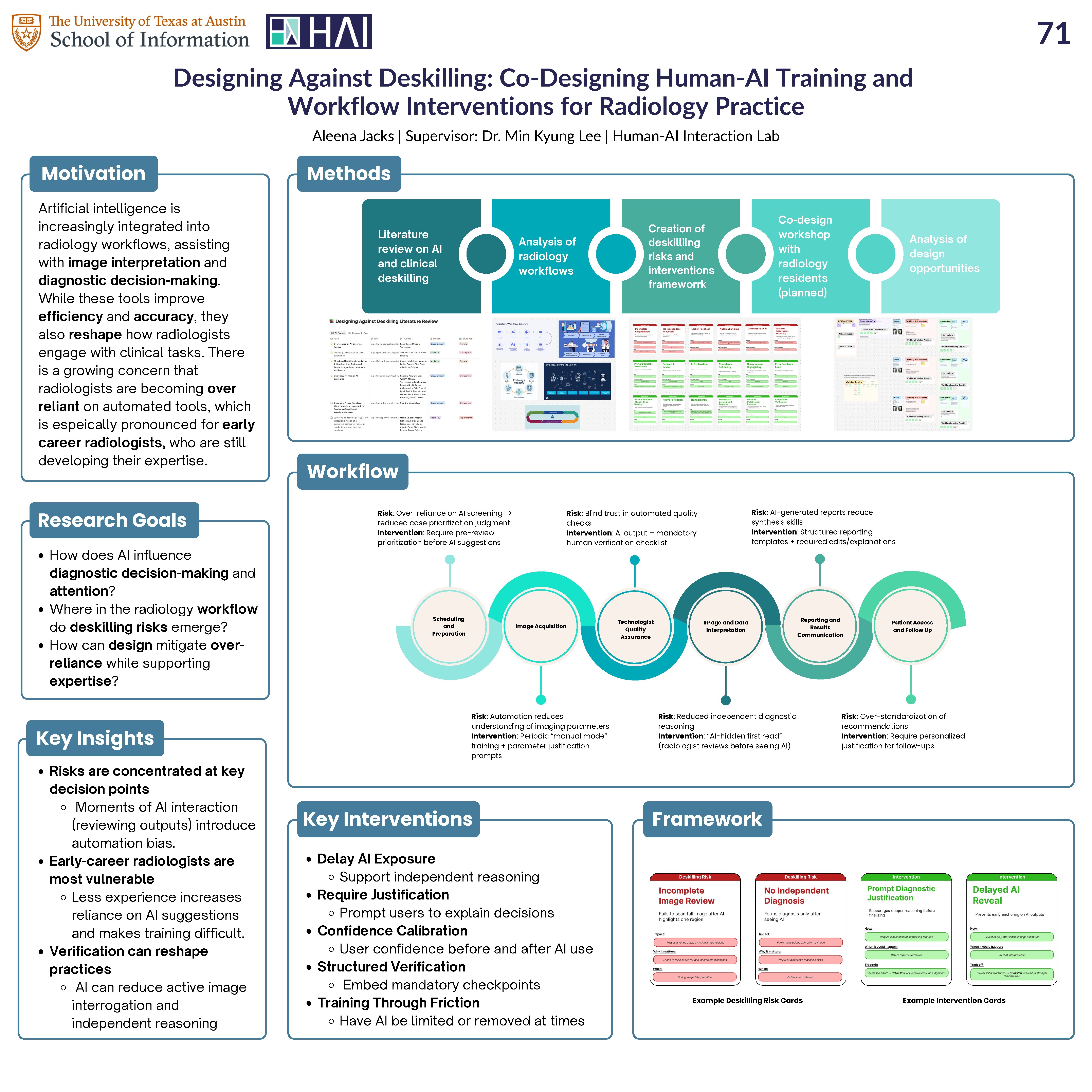
Aleena Jacks worked with professor Min Kyung Lee at the iSchool’s Human-AI Interaction Lab to develop her capstone research project, “Designing Against Deskilling: Co-Designing Human-AI Training and Workflow Interventions for Radiology Practice.”
The project was inspired by the concern that radiologists may someday become overly reliant on AI tools as such systems become more accurate and integrated into everyday workflows. “This overreliance can reduce independent diagnostic reasoning, weaken skill development and shift clinicians from active decision-makers to passive reviewers,” Jacks warns. “The problem is particularly important for trainees, who are still building foundational expertise and may not develop strong diagnostic skills if AI is introduced without thoughtful design.”
To combat this risk of deskilling in AI-assisted radiology, Jacks set out to develop a framework for a clear, actionable approach to utilizing AI systems that support both efficiency and long-term skill retention. This took the form of two sets of cards: a set of “deskilling risk” cards and a set of corresponding “intervention” cards.
“The risk cards define specific, observable behaviors, such as failing to form an independent diagnosis before seeing AI output or relying on AI-highlighted regions without fully reviewing the image,” Jacks explains. “The intervention cards then provide targeted design strategies to counter these risks, such as delaying AI output, requiring evidence-based verification or incorporating AI-free practice.”
Through this project, Jacks says she came to understand that deskilling occurs not through AI alone, but through decisions made – or not made – about how AI is introduced into workflows. She hopes to carry that lesson with her as she leaves the iSchool to continue to build her career.
“This project significantly shaped how I approach UX research and design in AI-driven systems,” Jacks says. “It reinforced the importance of designing not just for usability and performance, but for long-term human skill, judgment and accountability. In my future work, I plan to apply this mindset to ensure that AI systems enhance rather than replace human expertise, especially in high-stakes fields like healthcare, by positioning AI as a supplemental tool that supports and strengthens, rather than automates away, critical human skills.”
Kyle Castillo, Undergraduate Dean's Choice Award Winner
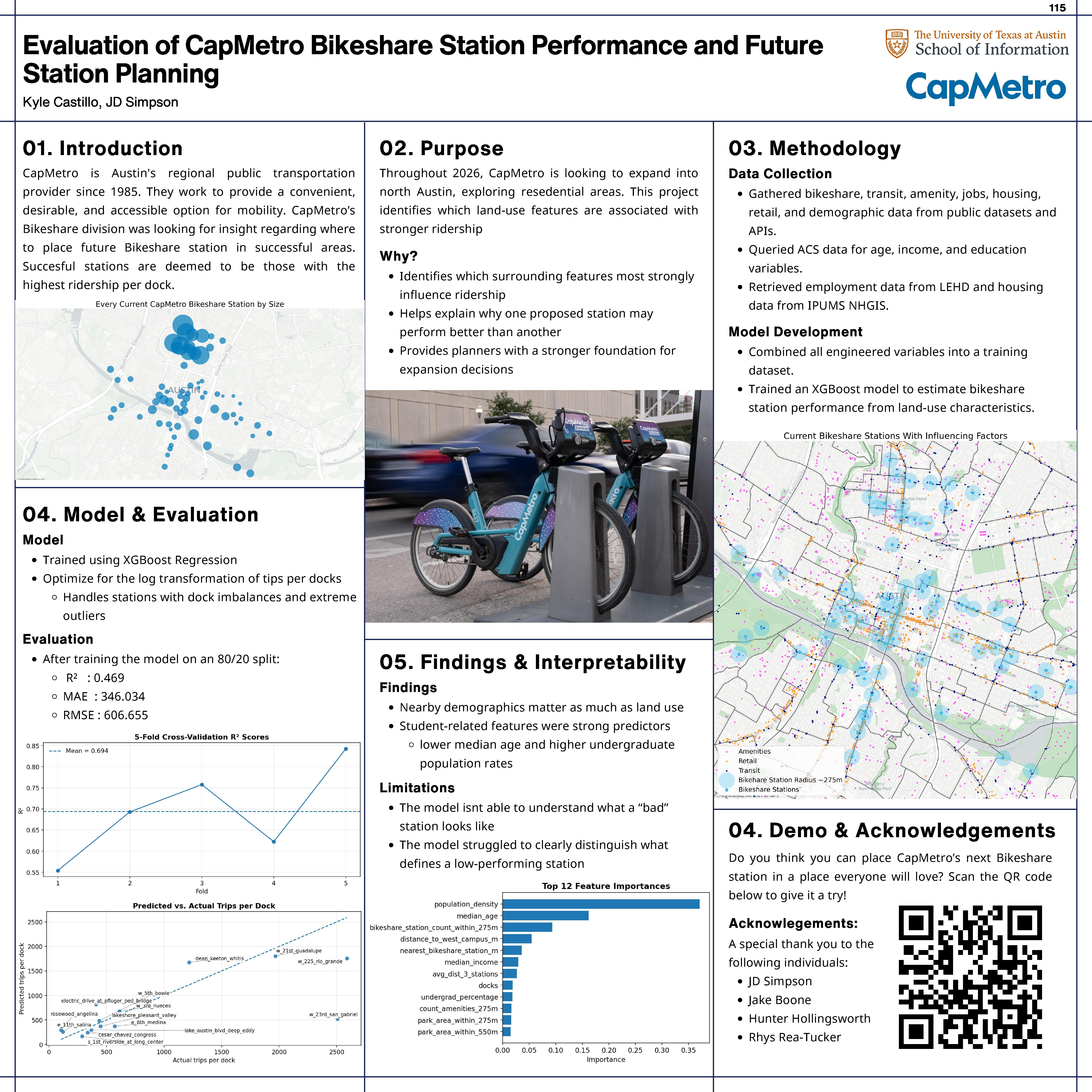
Kyle Castillo’s award-winning capstone project, “Evaluation of CapMetro Bikeshare Station Performance and Future Station Planning,” was carried out in partnership with CapMetro, Austin’s regional public transportation provider. One CapMetro transportation offering is an electric bikeshare program organized around dozens of charging hubs, from UT campus to downtown, the east side, South Congress and around Ladybird Lake. Throughout 2026, CapMetro is focused on expanding Bikeshare service to North Austin.
“Currently, future station selection relies heavily on experience and intuition,” Castillo says. “That experience is incredibly valuable, but communicating those instincts to leadership, investors, or other stakeholders is difficult without a model or clear evidence supporting them. My goal was to turn the insights hidden in CapMetro’s data into something more concrete and useful.”
At first, Castillo set out to build a model to help understand how the land around a bikeshare station affects performance, but the project soon morphed into something different and father-reaching.
“After weeks of mediocre model results, I realized the stronger question was not just about the land itself, but about who lives around the station. That led me to identify population density, lower income areas and younger populations as some of the strongest indicators of ridership,” Castillo says.
Not only the question Castillo was asking, but his intended project outcome, too, changed and grew over the course of the project, as he came to better understand the needs of the organization he was hoping to help.
“Although I initially planned to just build a model and share the source code, I realized it would be much more useful as an interactive demo where planners could click on potential station locations, see a ridership prediction, and understand what factors made that location stronger or weaker,” Castillo says. “This information could then be used to decide where to place future bikeshare stations.”
There were serious benefits for Castillo, too, in this more ambitious project. He had no previous experience in app-building; the interactive product helped him develop new skills in front-end development, deployment, model integration and user-centered design. As he graduates from UT, he hopes to put those skills to work perhaps in a similar environment. For the immediate future, he plans to continue working with CapMetro as a contractor or part-time employee, continuing the project that became his capstone.
Lucas McGill, Graduate Dean's Choice Award Honorable Mention
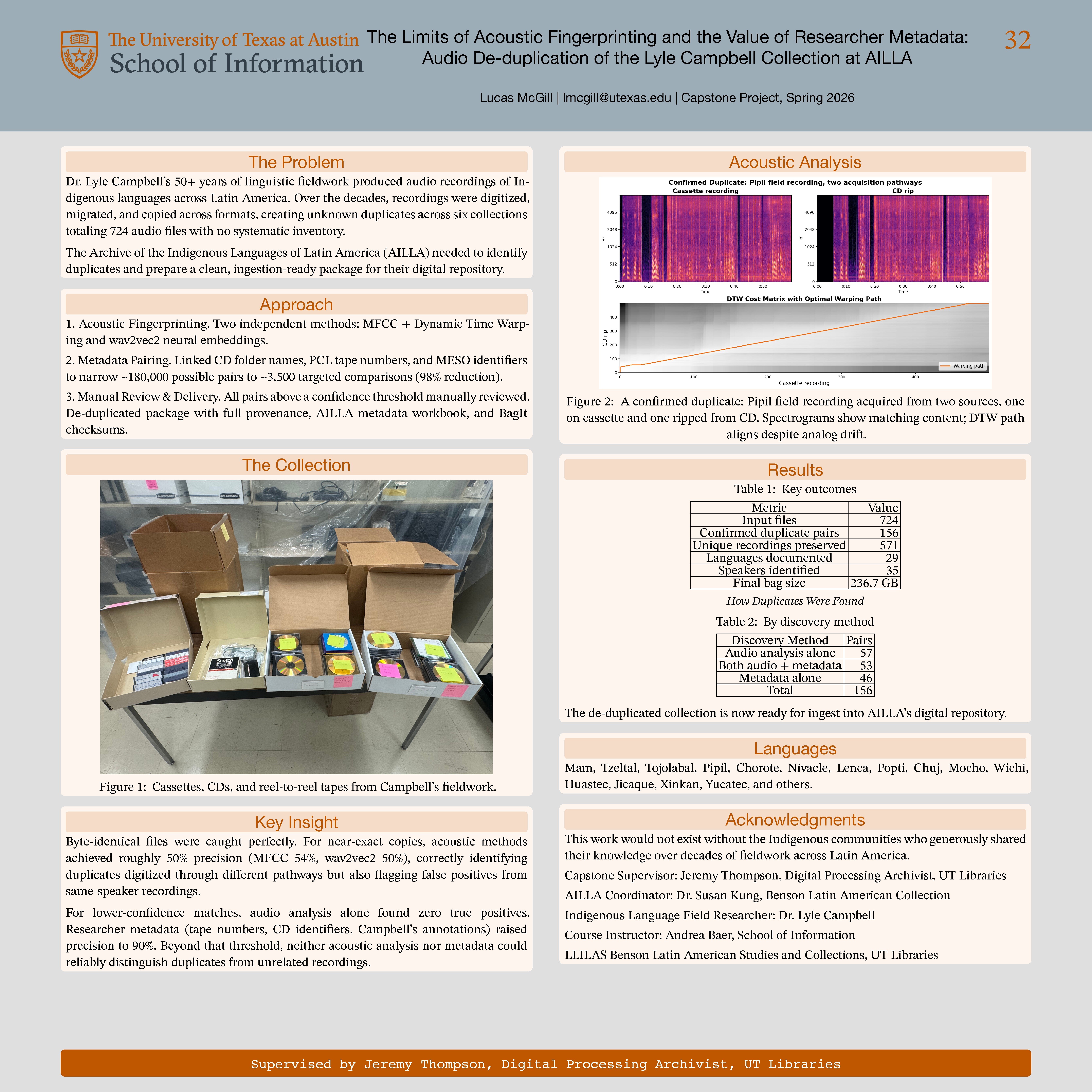
Graduating MSIS student Lucas McGill’s capstone project, “The Limits of Acoustic Fingerprinting and the Value of Researcher Metadata: Audio De-duplication of the Lyle Campbell Collection at AILLA” is an example of cutting-edge research taking place in the iSchool’s archival studies track.
McGill worked with the Archive of the Indigenous Languages of Latin America (AILLA), housed at the LLILAS Benson Latin American Studies and Collections at UT, and specifically with a collection of 724 audio records of Indigenous language field recordings (elicited word lists, oral histories, and grammatical tests) captured by the linguist Dr. Lyle Campbell. Because these are audio files of often rare languages, they can be challenging for archivists. To add to the difficulty, the files had, over the years, been digitized, copied, and migrated between formats and storage media multiple times.
“We had suspected duplicate recordings, but there was no way to tell what they were at a glance,” McGill says. “I set out to identify and remove the duplicates so the unique recordings could be made more accessible to researchers and to the communities they came from.”
McGill set out to create workflows that could identify duplicate files. He notes that, while an app like Shazam can identify commercial music tracks that have a stable mastered reference to match against, field linguistic recordings where no canonical version exists are much more challenging.
First, McGill used the audio production program Ableton to create artificial near-duplicate records, by simulating tape speed drift and artificially adding noise. This was moderately successful with some files but overall produced too many false positives. To improve this workflow, McGill incorporated researcher metadata and metadata records from the PCL into his script to generate a more targeted analysis.
“This cut comparisons the program had to make by 98%, which considerably decreased the number of needles and the size of the haystack,” McGill says. “At this point, I felt much more comfortable weeding through the manual comparison I had to make.”
Looking back at his project, McGill says his biggest takeaway is a healthy skepticism towards fast technological solutions to thorny archivist challenges. At one point, he attempted to use AI to compare files, he says, but that approach failed spectacularly, identifying matches in every file that contained Dr. Campbell’s voice.
“The real breakthrough did not come from trying to compute my way out of the problem,” McGill says. “It came from traditional archival methods. The answers I was looking for were within the metadata records from Dr. Campbell and the PCL digitization team. If I had to do it again, I would’ve started by identifying the records with the metadata, instead of starting with trying to brute-force a technical solution. There is a reason for archival tradition and why they teach this stuff in iSchools.”
Marsh Vo, Undergraduate Dean's Choice Award Honorable Mention
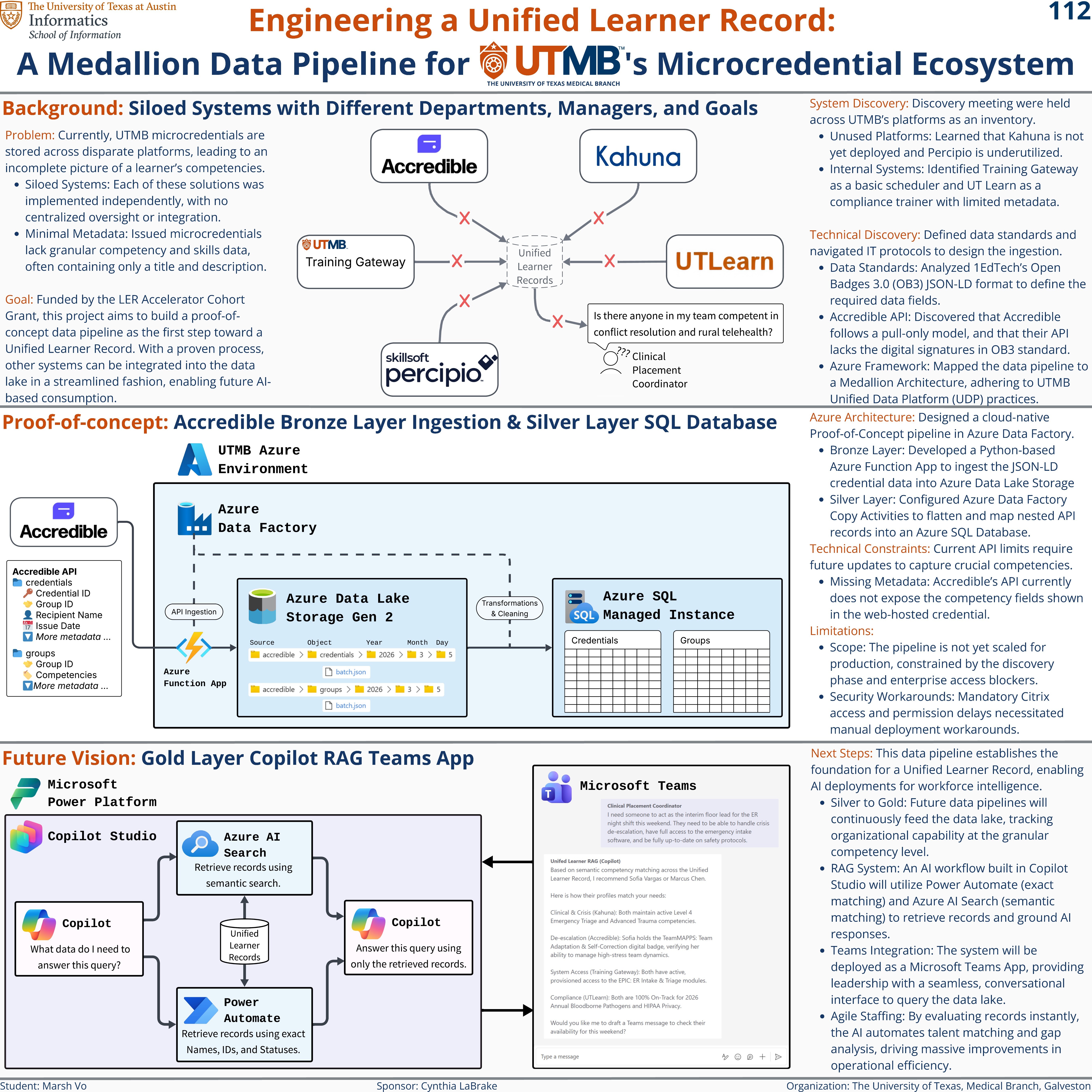
Marsh Vo’s capstone project, titled “A Medallion Data Pipeline for UTMB’s Microcredential Ecosystem,” was carried out in partnership with the University of Texas Medical Branch, Galveston (UTMB). Vo’s goal was to design a scalable cloud architecture that could unify the credentialing systems for UTMB’s Learning and Employment Record (LER) database. At the same time, he sought to gain hands-on experience as a data engineer in a Microsoft Azure enterprise environment.
“During the initial discovery phase, my project team found that employee competency data was siloed across five different vendor systems, making it nearly impossible to see an employee's full skill set,” Vo says. “Funded by the LER Cohort Grant, this project was created to break down those silos and establish the foundation for a unified learner record with digitally verified credentials.”
Over the course of the capstone project, Vo built a functioning proof-of-concept data pipeline that establishes a repeatable framework using Microsoft Azure medallion architecture to eventually integrate UTMB’s other disconnected systems. Additionally, he designed a conceptual AI agent to demonstrate how leadership could query this unified learner record in the future with natural language. The project was an important learning experience for Vo and the rest of the project team.
“I learned how rapidly project scope can shift in a real-world corporate environment,” he says. “I came in with big ideas, but quickly had to navigate enterprise IT protocols, security blockers, and access delays. Adapting to those organizational realities forced my team and me to narrow our scope to a preliminary, manual-trigger proof-of-concept pipeline. It was a crash course for me in what large-scale data projects look like in the real world, as this experience of organizational delays was corroborated by many of my professors.”
Despite bumps in the road, the hands-on project confirmed Vo’s excitement about the career path that the iSchool has prepared him for.
“While navigating the organizational blockers and access delays was definitely frustrating, the actual time I spent creating visual flowcharts, designing the architecture and watching my pipeline successfully execute made it all worth it,” he says. “This hands-on experience of designing, architecting and implementing made me even more confident that data engineering is the exact field I want to specialize in.”